What Are Cross-Selling and Upselling in Ecommerce?
Cross-sell and upsell emails are two of the most effective tools in an eCommerce brand’s email marketing toolbox. When implemented with precision, personalization, and consent, they deliver short-term revenue and long-term customer loyalty. But first, it’s important to know what each tactic means and how they differ.
What Is Cross-Selling?
Cross-selling is the strategy of offering complementary products to what a customer has already bought or is about to buy. Think of it as suggesting useful add-ons that enhance or complete the purchase experience.
In email marketing, cross-sell messages might be triggered immediately after a purchase or sent a few days later, recommending related items based on purchase behavior, cart content, or browsing activity.
- If a customer buys a phone, offer a case or screen protector.
- If they order a skincare serum, suggest the matching moisturizer or cleanser.
Goal: Increase the number of items per order and reinforce customer satisfaction by anticipating their needs.
What Is Upselling?
Upselling is the practice of encouraging customers to purchase a higher-value item instead of (or in addition to) what they initially planned to buy. It’s about moving them up the value ladder with better features, more benefits, or higher-tier offerings.
In email, this might involve recommending premium variants, bundle upgrades, or exclusive items right after an initial product view or purchase intent signal.
- Instead of a basic coffee machine, suggest one with a built-in grinder and timer.
- If they’re browsing a single vitamin bottle, highlight the value of buying a 3-month pack with a subscriber discount.
Goal: Boost average order value (AOV) by directing buyers toward more profitable options without being pushy or intrusive.
Why These Tactics Matter in Email Marketing
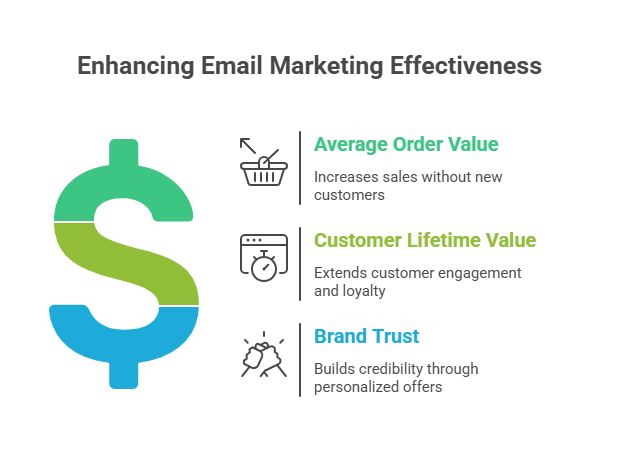
Email is a direct, consent-based channel optimized for personalized engagement. That makes it ideal for both cross-sell and upsell strategies. Done right, these emails can:
- Raise average order value (AOV) without acquiring new customers.
- Extend customer lifetime value (CLV) by showing care and relevance.
- Strengthen brand trust by tailoring offers instead of blasting promotions.
Cross-sell helps customers discover what they didn’t know they needed. Upsell helps them feel confident in choosing a better option. Both are powerful when your recommendations are timely, personalized, and backed by data.
Key Differences: Cross-Sell vs. Upsell
While both aim to increase revenue and deepen customer engagement, it’s important to apply them in the right context. Here’s a quick comparison:
| Strategy | Cross-Sell | Upsell |
|---|---|---|
| Primary Goal | Offer related or complementary items | Encourage a higher-tier or more expensive purchase |
| Trigger | After or leading up to a purchase | Before or during the purchase decision |
| Example Use Case | Suggesting phone accessories after phone purchase | Recommending a newer model with extra features |
Effective segmentation, clean data, and purchase context make all the difference. Whether you’re recommending a compatible add-on or nudging toward a premium version, your email must feel helpful. Never pushy or irrelevant.
Identifying the Right Products and Segments for Cross-Sell and Upsell Emails
Choosing what to promote (and to whom) is what separates high-performing cross-sell and upsell campaigns from generic blasts that waste email opportunities. Success starts with two core disciplines:
- Product selection: Are you recommending the right items to enhance or upgrade the experience?
- Customer segmentation: Are you sending them to the right people, based on actual behavior and data?
Selecting Complementary and Premium Products
Cross-sell emails work when the recommended products naturally pair with something the customer already showed interest in. The rule of thumb is relevance over revenue. If the product makes their recent or planned purchase more useful, convenient, or enjoyable, it qualifies.
Upsell emails should clearly show value over the original item. That value could be better features, longer-lasting use, exclusive access, or bundled savings, but it must feel like a beneficial trade-up. Not a sales pitch.
Use these criteria to guide selection:
- Functionality match: Does the add-on or upgrade increase utility or ease-of-use?
- Usage cycle: Does the product serve the same need, but for longer or at higher quality?
- Purchase timing: Does the offer make sense right after the original interest or transaction?
- Value justification: Is it easy to explain why the higher-priced item is better for them?
Segmentation Based on Intent and Behavior
One-size-fits-all upsell logic doesn’t get clicks. Intelligent segmentation does. Whether you’re targeting post-purchase, browse abandonment, or high-intent product views, your email system should group people by what they do. Not just who they are.
Start with segments built around:
- Purchase behavior: Past purchases signal preference and starting points for new recommendations. Look at SKU type, category, brand selection, order value, and timing.
- Browsing activity: Recent page visits, product views, and category hovers give insight into interest. Even if they didn’t trigger a cart event.
- Cart contents: Product combinations and cart value help determine what complements well or deserves a value-based upgrade.
Suggested Workflow Segments
- First-time buyer cross-sell: Segment: customers with 1 completed purchase. Trigger: 1–2 days after fulfillment. Offer: entry-level product accessories or refills.
- High-value cart upsell: Segment: customers with cart value ≥ [insert threshold]. Trigger: pre-checkout abandonment. Offer: bundle upgrade or subscription save prompt.
- Repeat buyer cross-sell: Segment: customers with ≥ 2 past orders in different categories. Trigger: recent browse event. Offer: relevant crossover product category.
Pro Tip: Use zero party data, like quiz answers or profile preferences, to refine segments beyond behavior. When shoppers tell you what they like, believe them.
The more you align product logic with behavioral signals, the more your customer sees emails that feel personal, timely, and helpful. That’s what earns clicks and revenue.
Crafting Effective Cross-Sell and Upsell Email Campaigns
Great strategy dies in a bad email. You can have perfect segmentation and brilliant product logic, but if the message doesn’t engage, it fails. Crafting a high-performing cross-sell or upsell email means dialing in the right combination of language, timing, design, and frequency. Here’s how to get there.
Subject Lines That Drive Opens
Your subject line is the gatekeeper. If it doesn’t catch attention or hint at personal relevance, the rest of the email gets ignored. A strong cross-sell or upsell subject line should feel timely, subtle, and customer-centric. Avoid sounding like a mass promo blast.
Use these principles:
- Trigger relevance: Reflect their recent order, view, or cart action (e.g., “Loved your [Product]? This pairs perfectly.”)
- Emotional benefit: Focus on what the upgrade offers them (e.g., “Upgrade your mornings with this easy swap”)
- Concise curiosity: Create intrigue without clickbait (e.g., “Did you forget this for your [Product]?”)
Pro Tip: Keep subject lines under 45 characters for mobile visibility and avoid using all caps or spammy language.
Personalized Product Recommendations
A good recommendation feels like a helpful suggestion from someone who knows you. Generic “you may also like” offers won’t cut it. Use dynamic fields to tailor product suggestions based on:
- Recent purchases: Insert accessories, maintenance items, or alternative upgrades.
- Browsing or cart activity: Serve products from adjacent categories or next price tier.
- Zero party data: Filter by preferences like size, skin type, or style when available.
Relevance is what makes a product module worth clicking. If you can’t justify why someone sees a product, rethink your logic or don’t send it.
Call-To-Actions that Convert
Your CTA needs to do more than just say “Shop Now.” It needs to guide the customer toward value. Choose language that supports the offer logic.
- Cross-sell CTA: “Complete the Set” or “Add the Perfect Pair”
- Upsell CTA: “Upgrade to Premium” or “See Better Options”
- Subscription CTA: “Save with the Bundle” or “Get More, Pay Less”
CTAs should be easy to find on all devices. Use a bold button with clear visual contrast. And if you’re offering a discount to sweeten the upsell, mention it in the button copy.
Email Timing: When to Send
Perfect timing makes the difference between value and noise. Cross-sell emails often work best after a transaction, while upsell emails succeed before checkout or shortly after product research moments.
- Post-purchase cross-sell: Send within 1–3 days of fulfillment. Frame it as a thoughtful follow-up, not a hard sell.
- Pre-checkout upsell: Trigger when someone abandons a high-value or single-item cart. Offer an elevated or bundled option.
- Browse-based upsell: Automate within 24 hours of viewing a product page with a higher-value option.
Set smart delays between email triggers to avoid overlap and prevent over-emailing. Use suppression logic to pause if the customer already engaged with a similar offer.
Email Frequency: Don’t Burn Out Your List
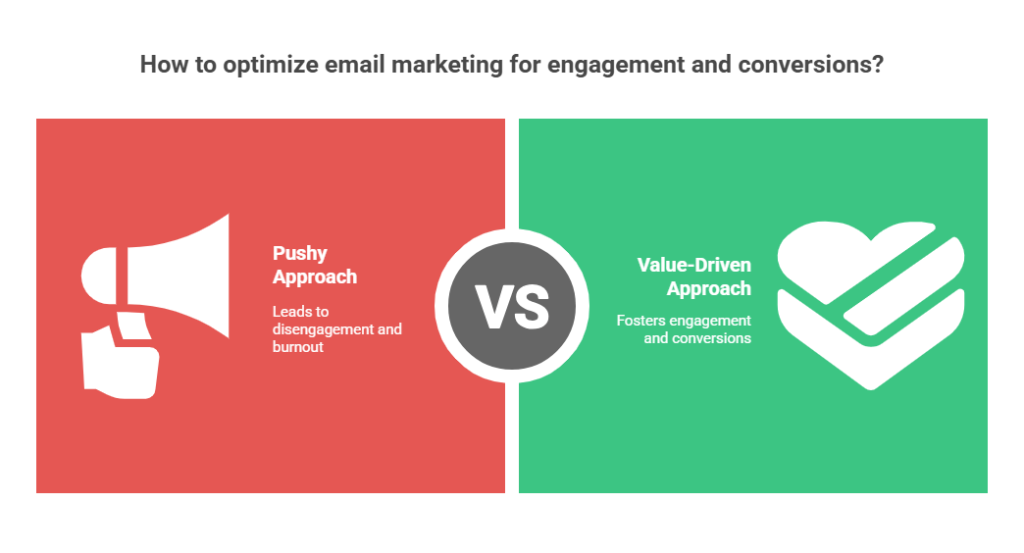
Your audience can tolerate more communication if it feels timely and relevant. They’ll disengage if you always push products with no context. Here’s how to keep it sustainable:
- Define limits: Set a maximum of [insert number] promotional emails per week per subscriber.
- Prioritize value: Only send cross-sell or upsell emails if product logic and timing make sense.
- Rotate offer types: Mix in education, brand storytelling, or usage tips with product pitches and upsells.
Pro Tip: Use behavior-based exclusions. If a customer opened a recent upsell email but didn’t click, pause for [insert time] before sending another offer-heavy message.
The bottom line: Every email you send is a chance to help the customer discover something useful. Not a chance to pitch harder. Respect their attention. Personalize based on intent. Make it obvious why your message matters now, and you’ll earn the conversion.
Design Elements that Enhance Cross-Sell and Upsell Emails
Design isn’t decoration. It’s delivery. Every element in your cross-sell or upsell email should serve one goal: get the right offer across as clearly and quickly as possible. Effective design amplifies the message, removes friction, and directs users to action.
Mobile Responsiveness First
Most of your emails will be opened on mobile. If your layout doesn’t adapt and render clearly across screen sizes, the tap never happens. Poor mobile design directly lowers clicks.
- Use responsive templates that automatically resize text and images for mobile.
- Design finger-friendly CTA buttons with at least 44x44px tap targets.
- Stack elements vertically to avoid side-scrolling or tiny text blocks.
Pro Tip: Test on real mobile devices before launching any campaign. Not just on desktop previews.
Product Image Placement That Converts
Lead with visual relevance. Your product image is often the first piece of content the subscriber will notice. Placement and quality matter.
- Place product images above the fold, ideally near or beside the offer headline.
- Use high-resolution images that load cleanly on retina displays.
- Show products in context when possible. Do it on a model, in use, or as part of a set.
Never send product modules with broken links, low-resolution thumbnails, or placeholder images. You only get one glance-worth of attention. Make it count.
Concise, Benefit-Focused Copy
In a cross-sell or upsell email, there’s no room for fluff. Your copy should communicate a clear benefit in as few words as possible.
- Headline: Focus on outcomes. “Upgrade mornings.” “Add what you’re missing.” “Your next favorite step.”
- Body: Use one or two short lines to explain what makes the product useful, time-saving, longer-lasting, or better suited to their needs.
- CTA: Make the next click obvious (and desirable).
Pro Tip: Mirror the language of the product they just interacted with. If they viewed a skin serum, your cross-sell copy should reference skin, hydration, or daily routine. Not generic “shop now” phrases.
Clear Visual Hierarchy
Good design guides the eye. Use hierarchy to make each part of the email easy to scan at a glance.
- Header: Set the theme or intent. Use font sizing that separates it from the rest of the email.
- Product module: Include title, price, image, and direct CTA. Stack modules if sending multiple recommendations.
- CTA button: Use contrasting colors and enough white space to make it stand out, even on small screens.
Keep background colors simple, use one or two main fonts, and make sure each element has room to breathe. Crowded emails get deleted fast.
Optional Enhancements (When Aligned with the Offer)
If your product logic supports it, consider these design features to increase engagement:
- Countdown timers: Only use when the offer has a real expiration. Don’t fake urgency.
- Product comparison blocks: Help frame upsell value by showing what more they get with the premium version.
- User-submitted visuals: (If you have consent) Show how other customers use the product. Keep it minimal and relevant.
The goal is clarity. When the design supports product relevance, timing, and clear direction, your email becomes effortless to act on. That’s what makes clicks and buys. Because it feels easy.
Automation Strategies for Cross-Sell and Upsell Emails
Great cross-sell and upsell emails don’t happen manually. Trying to hand-send product recommendations after every purchase or cart event isn’t just unsustainable. It’s ineffective. You need automation to react at scale, in real-time, with relevance.
Trigger-Based Email Sequences
Automation starts with choosing the right customer actions to trigger your messages. Cross-sell and upsell emails work best when they respond to specific signals that show strong intent or opportunity.
- Purchase confirmation or fulfillment: Trigger a cross-sell follow-up 1–3 days after an order ships. Assume interest is still high but now shifted toward accessories, refills, or complementary items.
- Cart abandonment: Use the abandoned cart event to promote premium versions or bundled upgrades before the decision is finalized.
- Product or category view: Set behavior-based automations after someone views a lower-tier product. Recommend the step-up product in your upsell sequence.
Each trigger should map to a goal. Cross-sell triggers aim to add items post-purchase. Upsell triggers aim to improve the cart before checkout or during early research.
Suggested Email Flow Templates
- Post-purchase cross-sell flow
- Trigger: Order marked as fulfilled
- Email 1 Timing: 48 hours after fulfillment
- Content: Thank-you tone with two product recommendations related to their purchase
- Email 2 Timing: 3–5 days later (if no click)
- Content: Reminder with added customer support angle or bundled offer
- Cart-based upsell flow
- Trigger: Cart abandonment with value ≥ [insert threshold]
- Email 1 Timing: 1 hour post-abandon
- Content: Show upgraded or bundled version of cart items
- Email 2 Timing: 24 hours later
- Content: Add value-based incentive or urgency if real (e.g. stock, expiration)
- Browse-based upsell flow
- Trigger: Viewed lower-tier product, but no cart action
- Email 1 Timing: Within 12–24 hours
- Content: Side-by-side comparison of viewed item vs premium version
Pro Tip: Add exit points in each flow. If the customer clicks, buys, or otherwise converts, suppress further emails in the series to avoid appearing pushy or redundant.
Leveraging Dynamic Content for Relevance
Automated flows don’t mean static messages. Use dynamic product blocks to insert specific recommendations based on what the customer did or bought. Email platforms with logic-based modules let you build one email template that changes content per segment.
Dynamic logic should reflect:
- Past SKU: Recommend accessories for the specific item purchased
- Cart contents: Suggest bundle upgrade if cart includes individual items
- Category affinity: Insert products from matching or adjacent categories
Pro Tip: Always include fallback logic. If you don’t have an exact match, show top-selling universal products or trigger a support-focused email instead.
Using Personalization Tokens
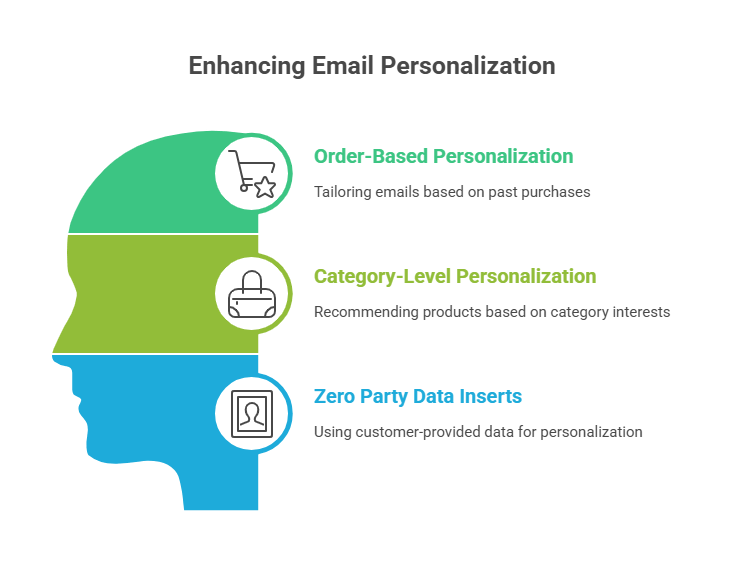
Email personalization goes beyond name inserts. Use tokens to reference specific products, brands, sizes, or attributes from the customer’s interaction history.
- Order-based personalization: “You picked the [Product X]. Great choice. Here’s what will make it even better.”
- Category-level personalization: “Since you’re into [Category Y], you might love this next-level product.”
- Zero party data inserts: “For your [skin type / lifestyle preference], this is a perfect next step.”
Pro Tip: Use variable fields only where context makes them feel natural. Don’t overload the email with too many personalized lines unless they all serve a single message thread.
Optimizing Automation Over Time
Set your automations live but don’t leave them untouched. Use A/B testing within flows to refine subject lines, CTA placement, product blocks, or delay windows. Monitor performance at each step to identify drop-off points.
- Are clicks low on the first upsell email? Test a stronger product value story.
- Are conversions low after cross-sell opens? Rethink the product match or delivery timing.
- Are unsubscribes high at any stage? Check email frequency or overuse of the same flow.
Use email flow metrics to fuel continuous improvement. Revenue from automation compounds when each sequence is tuned to actual behavior. Not just assumptions.
The goal: Build automated campaigns that feel like thoughtful 1:1 interactions, even when they scale to thousands. That’s what drives AOV and CLV without burning out your list or your team.
Compliance and Best Practices in Email Marketing for eCommerce
Email revenue is earned and never assumed. And compliance isn’t optional. If your cross-sell and upsell tactics ignore permission and privacy standards, you won’t just frustrate shoppers. You’ll damage long-term deliverability, burn your list, or risk legal issues.
Understand the Rules: CAN-SPAM and Permission-Based Marketing
The foundation of every legitimate email strategy in the United States is the CAN-SPAM Act. It governs all commercial email and includes specific rules you must follow. Even if the recipient already made a purchase.
Key CAN-SPAM Requirements:
- Consent: You must have permission to email someone. That can be explicit opt-in or implied (soft opt-in based on a recent purchase).
- Clear sender info: Your email must include a valid “From” name, physical business address, and contact method.
- Easy opt-out: Every email needs a visible unsubscribe link. It must work. And you must honor removal requests promptly.
- Truthful subject lines and content: No misleading language, deceptive headers, or hidden messaging.
Pro Tip: Even if someone bought from you once, that doesn’t mean you can keep sending promo emails forever. Design your flows with expiration windows or ask for continued consent after a cooldown period.
Build and Maintain a Healthy Email List
A healthy list is clean, permissioned, and engaged. Every cross-sell or upsell email you send should go to someone who wants to hear from you. That starts with acquisition and continues with routine maintenance.
Best practices to maintain list hygiene:
- Use double opt-in for new signups: Confirm intent and reduce fake or mistyped addresses.
- Suppress inactive users: Define a timeframe (e.g., 90 days of no opens) to pause promotional sends automatically.
- Remove bounces and spam complaints consistently: Clean these contacts out in real time or through weekly list sweeps.
- Segment based on engagement: Send higher-frequency promotional offers only to active subscribers. Keep others in a reduced-cadence nurture path or reactivation loop.
Pro Tip: Never buy or rent email lists. Repeat: never. Permission and relevance are what make cross-sell and upsell emails work. Cold contacts won’t convert, and purchased lists hurt your sender reputation.
Handle Unsubscribes the Right Way
Your unsubscribe experience matters. It’s your last impression. Make it respectable, easy, and compliant.
- Include an obvious unsubscribe link in every marketing email footer.
- Honor opt-outs promptly, ideally within minutes, and legally within 10 business days.
- Offer preferences when possible: Let subscribers reduce frequency or select what types of emails they want instead of forcing an all-or-nothing choice.
- Don’t guilt-trip or trick with small links, hidden text, or complicated opt-out processes.
Pro Tip: Build a preference center tied to your segmentation. When someone unsubscribes, give them the option to stay on for product guides, announcements, or education only, and remove them from cross-sell flows.
Avoid the Spam Folder: Deliverability Best Practices
Great segmentation and offers won’t help if your emails land in the promotions tab or spam folder. Deliverability starts with reputation and technical setup.
Best practices to improve email deliverability:
- Authenticate your domain: Set up SPF, DKIM, and DMARC. This proves you own the sender domain and builds trust with inbox providers.
- Send consistent volume: Avoid spikes in email sends. Add warming periods for new IPs or domains.
- Use a reputable ESP (email service provider): Platforms with built-in deliverability monitoring make it easier to stay compliant.
- Test before sending: Use inbox testing tools to preview how your email renders and scores across platforms and spam filters.
Pro Tip: Monitor key indicators like bounce rate, complaint rate, open rate, and block rate. If your metrics slip, pause higher-frequency flows like upsell sequences and focus on re-engagement or support-based content instead.
A Consent-First Approach Wins Long-Term
Cross-sell and upsell emails only work when trust is intact. Consent is the foundation. If a customer expects relevant offers and receives them in a respectful, timely way, you build loyalty and revenue. If not, you get flagged, ignored, or unsubscribed.
Before every email flow, ask:
- Did this person actively opt in or show enough intent to justify messaging?
- Do I have a compliant unsubscribe path built into this template?
- Is this offer tailored to what they actually did or bought?
If you can’t confidently say yes, don’t send it. Or better yet, fix your flow so you can.
The goal isn’t just more sends. It’s smarter, safer, permissioned communication that drives value both ways.
Measuring the Success of Cross-Sell and Upsell Email Tactics
You can’t optimize what you don’t measure. If your cross-sell and upsell email campaigns are running but you’re not tracking how they perform, you’re leaving money on the table. Or worse, burning out subscribers with unproductive messages.
Key Metrics That Matter
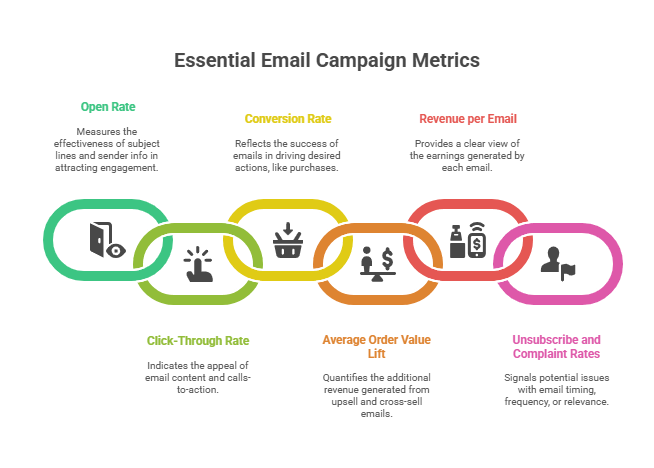
Every email campaign should be evaluated against clear performance indicators. When it comes to cross-sell and upsell specifically, your metrics must tie back to engagement and revenue impact. Here’s what to measure:
- Open Rate: Tells you how well your subject lines and sender info entice subscribers to engage. Low open rates can indicate poor timing, irrelevant offers, or a damaged sender reputation.
- Click-Through Rate (CTR): Shows how compelling your email content and calls-to-action are. A good CTR suggests strong product relevance and message clarity.
- Conversion Rate: Measures how many recipients took the desired action. Typically a purchase of the recommended product. This is the ultimate signal of offer alignment and trust.
- Average Order Value (AOV) Lift: Tracks how much additional revenue is generated from upsell or cross-sell emails compared to baseline AOV. This helps prove the value of each tactic.
- Revenue per Email (RPE): Provides a clear view of how much each email in your series is earning. Great for comparing performance across different flows.
- Unsubscribe and Complaint Rates: High rates here are a red flag. They suggest that the timing, frequency, or relevance of your messages are off.
Pro Tip: Don’t obsess over vanity metrics. A click means nothing if it doesn’t drive action. Start with metrics tied directly to revenue and engagement.
Creating Feedback Loops for Optimization
Measurement isn’t a one-time report. It should guide active adjustments so your campaigns keep getting more effective. Think of it as a feedback loop:
- Establish Baselines: Set benchmarks for each metric across current email flows. This gives you a snapshot of what “normal” performance looks like today.
- Track by Flow and Segment: Don’t lump all emails together. Compare metrics for high-spending segments, repeat customers, first-time buyers, and VIPs. This reveals who responds best to what kind of offer.
- Identify Drop-Off Points: Look for stages in the funnel where customers stop engaging. If open rates are fine but CTR is low, your subject line works but the message may fall flat.
- Test and Isolate: Use A/B testing to improve weak points. Try new subject lines, product arrangements, CTA wording, or timing delays. But test one element at a time to know what made the difference.
- Iterate fast but don’t chase noise: Small swings in performance might mean nothing. Focus on patterns, and give tests enough volume to deliver meaningful insights before making changes.
Segmented Reporting for Deeper Insight
Every segment performs differently. A blanket report across your full list can blur what’s actually working. Instead, break performance down by:
- Customer type: First-time vs. returning, one-time vs. subscriber
- Purchase behavior: High vs. low AOV, specific product categories
- Engagement level: Hot leads vs. idle or dormant subscribers
The same cross-sell email might earn solid revenue from new buyers and cause unsubscribes from loyal customers who already own similar items. Segmented reporting will show you when to restrain or rotate messaging accordingly.
Success Signals to Watch For
Once your campaigns are running well, here are signs you’re headed in the right direction:
- Increasing RPE over time: Your emails are becoming more relevant and higher converting.
- Improved engagement among repeat buyers: They keep clicking and buying additional items, not just once.
- Low unsubscribe rates during upsell flows: Messaging feels helpful, not promotional overload.
- AOV consistently trending upward: You’re influencing purchasing habits, not just responding to them.
Pro Tip: Build a tracking dashboard inside your ESP or reporting tool. Monitor KPIs broken down by campaign, product pair, and customer segment. This keeps optimization continuous, not reactive.
When to Kill or Freeze a Campaign
Optimization isn’t just about tweaks. Sometimes, killing a lagging email is the best decision. Know how to spot a failing upsell or cross-sell campaign by checking for:
- Sustained low open or click rates: Despite subject line tests and changed CTAs
- No conversion in multiple sends: Even across trusted segments
- Rising opt-outs or complaints: A sign that the frequency or content is turning people off
It’s better to pause and retool than to keep sending an offer that’s out of context. Even great products fail if their timing or recipient logic is wrong.
The takeaway: Measuring success isn’t about checking boxes. It’s about learning what matters to your audience and using those lessons to build smarter, cleaner, higher-yielding campaigns. In cross-sell and upsell, data is your best copywriter and your best bet for sustainable revenue.
Common Pitfalls to Avoid with Cross-Sell and Upsell Emails
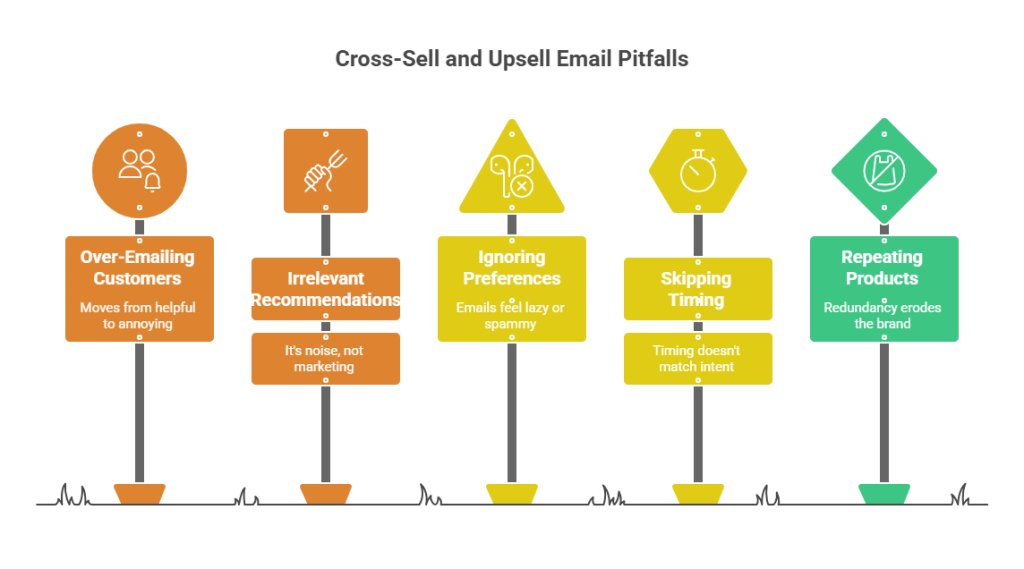
If your cross-sell or upsell emails aren’t converting (or worse, driving unsubscribes) you might be making one of the mistakes below. These missteps don’t just waste email real estate. They hurt engagement, lose trust, and reduce long-term customer value. Here’s what to watch for and how to correct course.
1. Over-Emailing Your Customers
Email fatigue is real. Just because someone bought doesn’t mean they want a new offer every day. Hitting subscribers too frequently with product recommendations can quickly move you from helpful to annoying.
- Don’t stack campaigns: If a customer is already receiving a welcome sequence or post-purchase series, avoid pushing additional upsell flows at the same time.
- Set send limits: Define a global frequency cap per address to prevent multiple promotional emails within a short time frame.
- Pause based on interaction: If someone doesn’t open or click the last upsell email, delay the next offer until there’s new behavioral activity.
Pro Tip: Use suppression logic to remove customers from upsell flows once they’ve purchased, clicked, or shown signs of message overload.
2. Irrelevant Product Recommendations
If the product doesn’t make sense to the customer, it’s noise. Not marketing. Poor product logic, lack of segmentation, or assuming interest without proof leads to embarrassing misfires.
- Offering incompatible accessories for the wrong device
- Pushing upgrades after someone already bought the premium option
- Promoting items from unrelated categories with no user intent signals
Fix it by:
- Using SKU-based logic: Match cross-sells to the exact product purchased, down to variant level.
- Checking segment membership: Exclude customers who already own the premium tier.
- Layering behavior filters: Trigger offers only after relevant product views, searches, or quiz answers.
Pro Tip: Send fewer, better recommendations. One high-logic offer converts more than four random ones.
3. Ignoring Customer Preferences and Zero Party Data
If your customer told you what they want so listen carefully. Zero party data like preference center inputs, quiz responses, or profile selections should guide your offers. Ignoring these signals can make your emails feel lazy or spammy.
- Sending fragrance products to someone who opted for fragrance-free
- Promoting men’s items to a women’s skincare quiz respondent
- Ignoring dietary preferences revealed in a product discovery form
Respecting zero party data means:
- Filtering product suggestions based on stated preferences
- Segmenting flows by lifestyle or use-case input
- Suppressing irrelevant offers tied to excluded product types
Pro Tip: If zero party data lives outside your ESP, sync it in using tags, custom properties, or API updates before triggering product emails.
4. Skipping Timing and Context
Even the perfect product is wrong when the timing doesn’t match intent. Sending an upsell before the buyer finishes researching basic options can backfire. Pushing a cross-sell a month after delivery often misses the purchase window.
Root timing pitfalls include:
- Triggering too soon: Sending a cross-sell before the product even arrives
- Triggering too late: Offering accessories after the customer has moved on
- Triggering during discount fatigue: Stacking upsell offers right after a big sale event
The fix: Tie each email to a relevant user action on a realistic timeline. Not every promotion needs to go out the door instantly. Use smart delays and trigger logic based on fulfillment, session recency, or re-engagement thresholds.
Pro Tip: Test delay windows in your flows and monitor performance. What you think is timely may still be too early (or too late).
5. Repeating the Same Products or Messages
Redundancy is brand erosion in disguise. If customers keep seeing the same product in every email, they will stop paying attention. Or worse, assume you’re out of fresh value to offer.
- Sending the same cross-sell added to multiple sequences
- Using identical subject lines across flows
- Overusing one “hero product” without variety or personalization
Prevent repetition with:
- Exclusion lists: Tag recipients by product exposure, and suppress repeated content
- Content rotation: Use dynamic modules that rotate by engagement history, not just cart or purchase behavior
- Testing frameworks: Develop a content calendar for cross-sell/upsell emails that rotates by month, segment, and behavior
6. Neglecting Deliverability Signals
If your emails are landing in the promotions tab or spam folder, none of your segmentation or product logic matters. Frequency, irrelevance, and bad engagement tank domain reputation fast.
Signs you’re hurting deliverability:
- Few opens after list-wide upsell sends
- Trickling engagement only from new subscribers
- High hard bounce or spam complaint ratios
How to fix it:
- Audit your volume and pacing
- Rewarm segments using high-engaging non-promotional messages before sending another offer
- Focus cross-sell and upsell messages only on active, opted-in subscribers
7. Forgetting That Trust Is Earned, Not Implied
The biggest pitfall is forgetting who you’re talking to. Just because someone gave you their email, or even bought, doesn’t mean you have blanket permission to send irrelevant marketing forever. Cross-sells and upsells should feel like a service, not a cash grab.
Ask these before every send:
- Why does this offer matter to them right now?
- Does this recommendation make their original product experience better?
- Will this email feel like a helpful touchpoint or a brand misstep?
If you can’t answer with confidence, don’t hit send. Reset your logic, check your segments, or rebuild flows around more recent behavior or real preferences.
The takeaway: Great upsell and cross-sell email strategies respect the customer first. Avoid the traps above, and your emails won’t just sell more. They’ll reinforce trust, relevance, and longer-lasting relationships.
FAQs: Cross-Selling and Upselling via Email
1. Should I use these tactics in flows or campaigns?
Both. Flows for automation, campaigns for timely promos.
2. Do I always need to offer a discount?
No. But discounts increase urgency. Use sparingly.
3. Can I use one email for both cross-sell and upsell?
Yes, but test carefully to avoid decision fatigue.
4. How do I know which products to suggest?
Use order data, browsing history, and customer segments.
5. What’s a good conversion rate for these emails?
2–5% is solid; some brands see 10%+ with smart targeting.